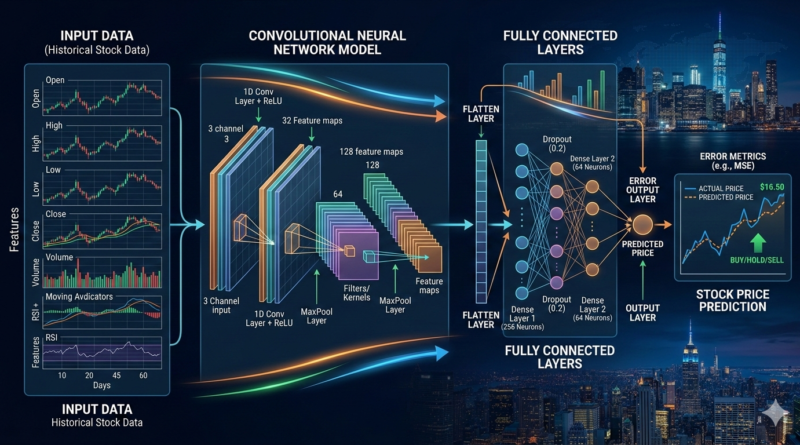
Convolutional Neural network (CNN) for stock market prediction
Introduction:
Convolutional neural network has been effectively using for stock market prediction, in which financial time series have been treated as 1D signals or 2D images. In such a network, the complexion and non-linear patterns in price data are classified without any extensive manual feature engineering.
What is CNN Model:
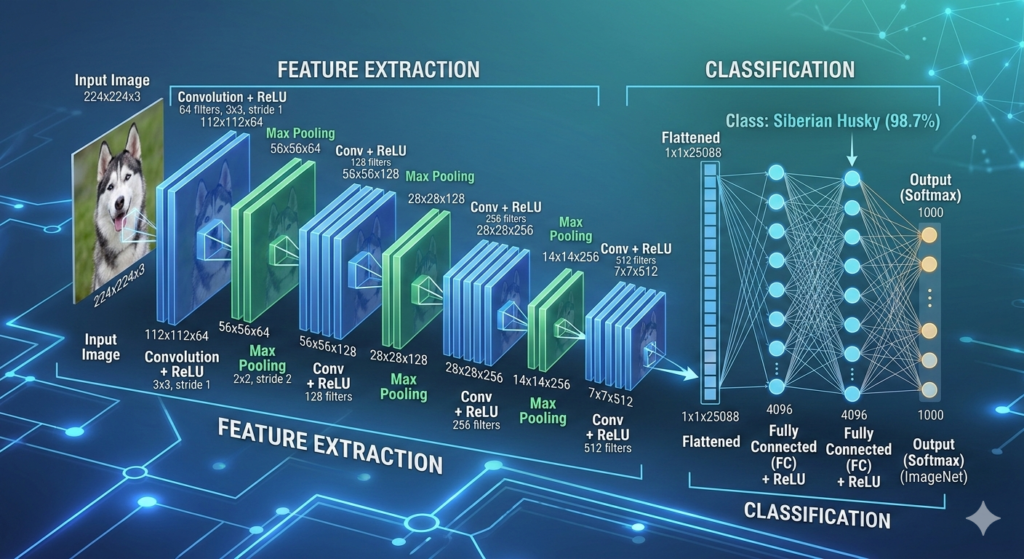
To understand CNN models, you need the basic understanding how machine learning actually works. CNN models are used to scan historical data to detect price movements or trends as well as often outperforming traditional methods with up to 91% accuracy in 30-day forecasts, especially when combined with technical indicators. This model is used on 1D time series data to convert them into 2D image like matrices. 1D is directly applied to time-series sequence with the purpose to scan the patterns by using filters so that short term trends could be detected and 2D as image to classify the future price trends i.e. buying, selling, and holding as stock in Godown etc.
This model processes input data through multiple layers by using convolutional operations. This model applies filters to capture the patterns like spikes٫ dips٫ and transitions. As the financial data is always highly volatile and noisy therefore٫ can lead to low accuracy if model is not properly designed. So٫ to balance the speed of computation and the efficiency of the model٫ several tests were made and it was decided to choose 06-number of layers because the number of layers are very important in the functioning of a model.
Prediction of Stock Market Price & Application of CNN Model:
The prediction of share value involves the forecast for the future value movement of the stock from Godown to market based on historic data. Therefore, CNN model can be used for time series analysis including stock market data as well as for detecting the complex patterns. However, it requires low parameters and captures short term dependance.
Key Aspects of CNNs for Stock Market Prediction:
Following are the key aspects of CNNs for stock market prediction:
- Data Representation:
Historical data in terms of its price, volume, and technical indicators is converted into 1D vectors or 2D images.
- Feature Extraction:
Kernels/filters are used in convolutional layers in order to identify local patterns/spikes/dips/trends.
- Pooling and Layers:
Max-pooling layers are helpful in reducing complexity of data whereas stacked convolutional layers are helpful in extracting abstract features, which are usually followed by fully connected layers for mapping purpose.
- Performance:
CNNs are used to achieve high accuracy in stock market prediction.
Challenging Nature of Stock Market prediction and CNN model:
Stock Market prediction is a challenging task due to volatile and non-linear nature of the financial markets. The CNN model predicts the stock market prices more effectively whereas the traditional models often failed to capture the complex patterns in the data. The CNN models automatically learns and extracts relevant features from the raw material/data by enhancing the prediction accuracy. If we compare CNN model with other one, the performance of CNN model is outclassed in terms of accuracy of prediction.
Conclusion:
Predicting the trend of stock prices is a hard task due to numerous factors and pre-requisites that can affect price movement in a specific direction. Due to powerful data processing capabilities, the deep learning remarkably results in the field of finance has been achieved.
In China, there are around 200 billion stock investors but the number of people who are responsible for making profit from the stocks market are very small. If you want to win from the stock market, you need proper and appropriate analysis of data. You must study the market tendency of the stock price historically to determine whether the stock market trend will go up or down in the future. Thus, CNN model is helpful in this regard.
Frequently Asked Questions
What are the commonly used tools in CNN models?
There are two commonly used tools in CNN models:
- TensorFlow/Keras: This tool is useful in building and training CNN models on normalized data.
- PyTorch: This tool has been frequently used for applying custom 1D CNN architectures with Huber loss in which outliers are handled.
What are the limitations of using CNN Models?
Firstly, Stock market data is usually noisy. Thus, CNNs could be overfit if not regularized in a proper manner.
Secondly, Standalone CNNs do not predict frequency or progressiveness of patterns. Thus, leading to lower returns when compared to hybrid and trend-following strategies.
What are the top commonly used Architectures and Techniques for CNN?
Following are the commonly used architectures and techniques for CNN:
1D-CNN: It can directly processes time-series data.
2D-CNN (Image-based): It can convert time series into image format.
ResNet: It can be used along with image-based techniques for feature extraction.
Loss Functions: Huber loss function is often used to handle high volatility and outliers.
Optimization: The Adam optimizer is used to prevent overfitting.
What are the main Applications of CNNs?
CNNs are applied in computer vision to classify image, to detect object, as well for segmentation, facial recognition, and video analysis.
Why CNNs are preferred over standard Artificial Neural Networks?
Standard ANNs became fail for image data as spatial relationships are not preserved in it. Thus, requiring too many parameters, leading to overfitting and inefficiency. Therefore, CNNs are preferred for such purpose.